
 –Angbuilgu Sundial
The last palace that we visited was Changyeonggung, though we still have ticket for our fifth palace, I knew for myself, that we will not able to visit it because the next day was our last day and we were booked for another tour. Anyway, though there were still few raindrops when we were at Changdeokgung, we were unstoppable to continue our walk. We entered in the gate of the palace from Changdeokgung which is called Hamyangmun.

–Hamyangmun (near the stair)

–bridge

–Tongmyeongjeon

–Yanghwadang
Since our tour did not start at the main gate of the palace, we saw the buildings in not particularly order. We started to walk in the area of Tongmyeongjeon and Yanghwadang. Based from handbook guide, Tongmyeongjeon was the queen’s bed chamber. Beside the building, there is a pond, with a bridge in the middle of it. While reading the information, I felt ecstatic because it was mentioned in the footnote in the guide that it was near the area of Tongmyeongjeon where Jang Ok-jeong (maid-in waiting become queen, deposed as consort and killed herself by poison, queen of King Sukjong in Dongyi historical drama) buried a puppet of the Queen together with dead animals which was the curse she laid for Queen Inhyeon (the current queen of King Sukjong in Dongyi). That piece of information is interesting. While the other building beside Tongmyeongjeon which is Yanghwadang where King Injo stayed.


–Gyeongchunjeon
Another area nearby Tomyeongjeon is called Gyeongchunjeon and Hwangyeongjeon. Gyeongchunjeon was sleeping quarters of King Seongjong (son of Queen Insu who become a regent for some years when his son was still young). It was the place of queens and princesses because future kings such as King Jeongjo and King Heonjong, King Jeongjo himself wrote a plaque which means “Birth Hall” and hung above the entrance. Hwangyeongjeon was the residence of kings and princes.

–Hwangyeongjeon

–Haminjeong
We moved to another area and look again what’s the building mean and the guide-book mentioned that it is called as Haminjeong which used by king to receive officials and hold banquets. Then we found as well the Sungmundang, its name written by King Yeongjo (son of King Sukjong and Dongyi in the drama) still hang. Here the king threw banquets for state affair discussions and classical literature.


–Sungmundang

–Binyangmun (near Sungmundang)
Next building we checked is called Munjeongjeon which is a council hall where king usually dealt with routine state affairs. One interesting information found in the footnote of the guide, that the courtyard in front of this building, the most tragic incident of the century happened. Prince Sado (father of King Jeongjo) was reported to be mentally ill and King Yeongjo were so furious that he ordered to put the prince in rice chest and sealed alive (where the prince died after 8 days).

–Between Munjeongjeon and Muyeongeonjeon
Then we move to another area called Myeongjeongjeon and vicinity. Here we found the main hall of the palace which is Myeongjeongjeon. Here most of the state affairs such as royal coronations, royal weddings, royal banquets were held.

–Myeongjeongjeon (back)


–Myeongjeongjeon
–Inside Myeongjeongjeon
–Myeongjeongjeon Vicinity

–Myeongjeonmun

–Okcheongyo(bridge) and Myeongjeonmun(gate)
Next area we passed by is Honghwamun and vicinity. Here we found the gate to Myeongjeonmun to Myeongjeongjeon. Then the famous Honghwamun, this gate where King Yeongjo went out to gather the opinions of peasants and scholars alike for Equalized Tax Law where most of his ministers opposed. Another interesting fact that I learned from the handbook guide was the footnote telling us that it was the same gate where people crowded to rally for the crown prince, he is Prince Sohyeon (oldest son of King Injo who become hostage for years during Qing dynasty but died through poison few days after returning in from Qing). I remember he is the same prince that I am currently watching historical drama right now entitled The Three Musketeers. Let’s wait and see what I am going to learn in that historical drama once it’s finished airing.

–Honghwamun
After coming from Honghwamun, we went out at the right side door and moved to Yeongchuncheon and Jipbokheon area. I learned that the area was residences of concubines. Jipbojheon building was where Crown Prince Sado and King Sunjo were born. Yeongchuncheon was unknown building before but become King Jeongjo’s study room and sometimes for handling routine state affairs.

–Yeongchuncheon

–Chundangji
We passed the Inner Palace site where court ladies live here. Some of the royal princesses also lived here. But currently we saw the place as wooded area full of trees and gardens. Probably the site was not yet restored. We continue our walk until we found a beautiful and large pond, and based from map, the pond named Chundangji. The large pond was not the original pond, it was the site where the king did engaged in farming while the queen engaged in raising silkworm. The original pond is the small pond which is not visible in the photo that I tool while I was at the front of the pond.
Because its getting dark and we are aware that the palace is open until 6PM, we hurriedly went back in Honghwamun area so we can exit easily. In this walking tour we missed three areas namely: Gwandeokjeon and Jipchunmun, Eastern Palace Site and Gwolnaegaksa. Those three are more on sites as of that time, probably South Korea has still plan to restore the site in due time. I enjoyed another walking tour in the palace. While inside the palace and seeing historical buildings makes me feel that I was returning in the past time of Joseon. I enjoyed the tour because I am somewhat familiar with their history, maybe to other people, these are just mere buildings but for me, they are truly treasures that South Korean must keep it for more many years to come so next generation will appreciate their history again.


 Constitutional Court of Korea
 Corner of Bukchon-gil and Gahoe-ro


 Vicinity area of Bukchon Traditional Cultural Center
 We tried to follow the map. But were not able to follow it as is, because sometimes we were lost in the village until we find ourselves again based on the map. Here I will not tell the story based on the map but based on what we have seen so far inside the hanok village. From cultural center, we walked straight along Gyedong-gil (Alley) and from what I learned in the map guide, this alley is one of the original streets that already existing during Joseon period. This is one of the street that still remaining the same as before (of course the looks are different nowadays but what I am saying is the alley itself). In this street we saw coffee shop, art shops and stores in hanok which is unique, because the traditional ambiance of the place can still be felt. We found the guest houses along the alley as well. One significant hanok is the Bukchon Guest House which is before called as Bae Ryum’s House in Gye-dong. We walked up to the top end of the alley where we reached Changdeokgung-gil alley. Here we saw Choong Ang Middle and High School. Along Changdeokgung-gill alley while facing the school we decided to turn right even we saw that the alley is ascending.
 Gyedong-gil (Alley)


 Some of the hanoks that we found while touring Bukchon Village


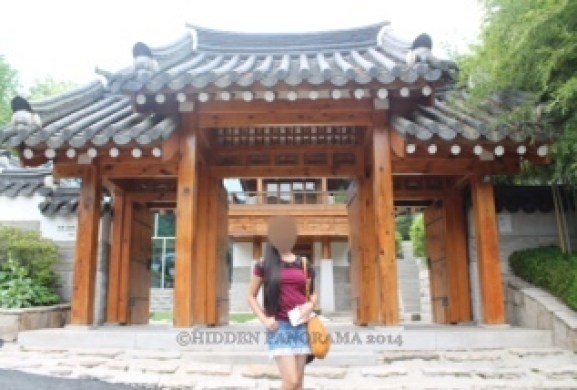

 Baek Hongbeom’s House in Wonseo-dong


 Han Sangsoo Embroidery
 Donglim Knot Workshop
 After taking some photos at Han Sangsoo Embroidery, we continue to proceed to the next site view. We used again the map to locate where it is. Until we found Donglim Knot Workshop. Then we strolled in Gahoe-saesak-gil alley until it reached the end. Next, we crossed the Gahoe-ro street. We walked again, but this time it’s along Bukchon-Hanok-gil alley. We walked until we found the 5th View which is Gahoe-dong alley. So far, from the time we started walking around Bukchon Village, this is one of the area that I like, I can really feel that we are inside the Hanok Village. And we are not the only one who enjoyed this alley, most of the tourist comes, they enjoyed it too. We took our time to take photo shots from the bottom (5th View) and from the top (6th View) of the alley, both ends offer great and different views. Before returning at the bottom of Gahoe-dong, we tried to find another way, until we found the 7th View which is the 31 Gahoe-dong.

 5th View at Gahoe-dong alley (below)
 6th View at Gahoe-dong alley (top)
 7th View – 31 Gahoe-dong

 Jangandang Internal Snapshot
 Jaseongdang site
 Gwanmungak site

 King Sejong Portrait
 Enterprize


 Inside the cabin of the ship

 Leaving Victoria Harbour in Docklands

 On our way to Bolte Bridge
 With the sunset view on the way


 Rigging Climb of Enterprize


 Snapshots of surrounding area


 Limelights of Victoria Harbour


 Bolte Bridge on our way back to the harbour


 Victoria Harbour at night
 At Waterfront City Marina


 Public Art Display at New Quay Promenade beside Waterfront City Promenade




You must be logged in to post a comment.